
Salesforce Implementation
Salesforce Implementation Services for Your Business
Your trusted Salesforce implementation partner in customizing, integrating, & getting the most out of Salesforce.
Our Case Studies


Trust Our Salesforce Implementation Consultant & Stand Out from the Crowd
Our Salesforce implementation specialists help businesses plan, configure, customize, integrate, and optimize Salesforce around their business processes and goals. With experience across the Salesforce ecosystem, Cloud Analogy supports organizations through implementation planning, data migration, integrations, customization, deployment, training and ongoing optimization.
0
%
Boost in Productivity
0
%
Improvement in Workflow Efficiency
0
%
Faster Decision-Making
0
%
Increase in Customer Satisfaction
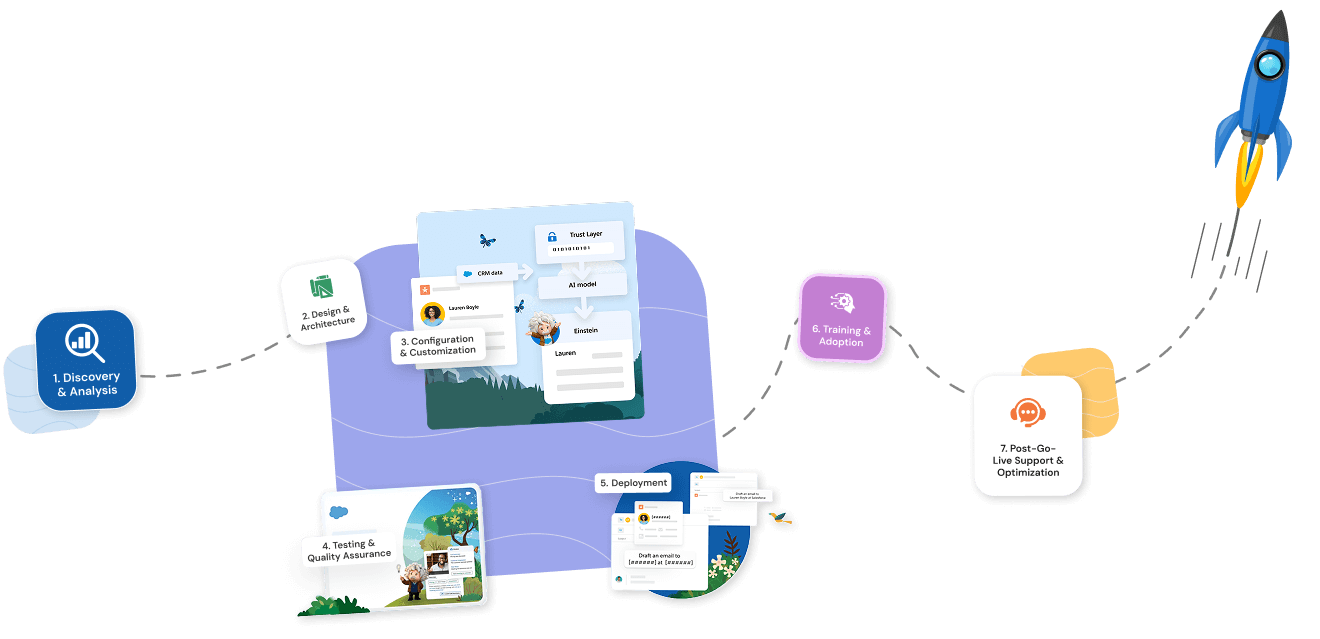
Our Approach To Salesforce Implementation Success
Whether you’re starting a new Salesforce implementation or improving an existing Salesforce org, our team helps you plan, build, deploy, and optimize your solution around your business requirements.
Discovery & Requirements
Understand your business processes, goals, users, and Salesforce requirements to define the right implementation approach.
Strategic Planning
Develop an implementation roadmap covering solution design, configuration, integrations, data migration, testing, and deployment.
Configuration & Customization
Configure Salesforce and customize the platform around your business workflows, automation needs, data, and user requirements.
Deployment & Adoption
Test and deploy the solution, train users, address post-launch needs, and support ongoing Salesforce optimization.
Why Does Your Business Need Salesforce Implementation Services?
 Complex Customization Needs
 Complex Customization Needs
 Adapting Salesforce to your business processes, workflows, and user requirements.
 Data Migration Hurdles
 Data Migration Hurdles
 Cleaning, mapping, and migrating legacy data while maintaining data relationships and integrity.
Cost Overruns
 Cost Overruns
 Managing project scope, customization, integrations, and other factors that can increase implementation costs.
 Complex Integration Requirements
 Complex Integration Requirements
 Connecting Salesforce with the CRM, ERP, marketing, finance, and other systems your business already uses.
Optimizing Reporting & Analytics
 Optimizing Reporting & Analytics
 Configuring reports and dashboards to give teams the business insights they need.
Ensuring Data Accuracy
 Ensuring Data Accuracy
 Clean, map, migrate, and validate business data before and after it is moved into Salesforce.

Expert Salesforce Implementation Services Across Salesforce Products
Innovative Salesforce Solutions for Various Industry Verticals
Our Results Tell The Story


Cloud Analogy has made a significant impact on our business success. Cloud Analogy helped our company to transform for good and supported us in implementing, customizing, and upgrading the organization's reputation. The work delivered was fantastic, the way I structured and wanted it to be, and it was according to my expectations. They managed the job well, and I am impressed with how Cloud Analogy and the team got the project done on the given deadlines.
Jonathan Matal Renovo Financial

Ready to Start Your Salesforce Implementation?
Talk with our Salesforce CRM implementation specialists about your business requirements, Salesforce environment, integrations, data, and implementation goals. We’ll help you plan and build a Salesforce solution around how your teams work.

Frequently Asked Questions
Salesforce implementation services help a business set up and tailor Salesforce around the way its teams actually work. This can include understanding business requirements, designing the solution, configuring Salesforce, building automations, migrating existing data, connecting other systems, testing the setup, training users, and supporting the launch. The exact scope depends on the Salesforce products, processes, data, and integrations involved.
A Salesforce implementation can include discovery and requirements gathering, solution design, Salesforce configuration, customization, automation, data migration, integrations, security setup, testing, user training, deployment, and post-launch support. Not every project needs all of these activities, so the scope should be based on your business processes, existing systems, data, and Salesforce requirements.
A Salesforce implementation specialist turns business requirements into a working Salesforce solution. Their work can include understanding existing processes, mapping requirements, configuring Salesforce, setting up automation, coordinating data migration and integrations, testing the system, supporting deployment, and helping users adopt the new setup. Depending on the project, a specialist may also help improve an existing Salesforce org rather than starting from scratch.
There is no single timeline for a Salesforce implementation. A focused implementation with straightforward processes and limited integrations may take several weeks, while a multi-cloud or enterprise project involving complex data migration, custom development, and multiple integrations can take several months. The most reliable timeline comes after discovery, when the implementation team understands the scope, dependencies, data, integrations, and testing requirements.
Salesforce implementation cost depends on the size and complexity of the project rather than just the number of users. Key factors include the Salesforce products being implemented, business-process complexity, data migration, integrations, custom development, automation, testing, training, and post-launch support. Salesforce licensing is also a separate consideration, so businesses should evaluate implementation services and ongoing platform costs together when planning their budget.
A typical Salesforce implementation follows five broad stages: discovery and requirements, solution design, configuration and customization, testing and deployment, and user adoption and optimization. Data migration and integrations usually run across several of these stages rather than being treated as a single final task. The exact process changes based on the Salesforce products, existing systems, data, and business requirements.
Yes. Data migration and integrations are commonly part of Salesforce CRM implementation projects when a business is moving information from an existing CRM, database, spreadsheets, ERP, marketing platform, or other business system. The work can involve data cleansing and mapping, migration planning, integration design, testing, and validating that information moves correctly between systems.
It depends on the complexity of the project and the capabilities of your internal team. An in-house team may be suitable for a straightforward implementation when you already have Salesforce administration and technical expertise available. A partner can be useful when the project involves complex business processes, multiple Salesforce products, data migration, integrations, custom development, or a need for specialized implementation experience. Some businesses also use a hybrid model, with a partner handling the initial implementation while an internal team takes over day-to-day administration.
Look for a specialist or implementation team that can demonstrate relevant Salesforce experience, a clear implementation methodology, experience with the Salesforce products and integrations your project requires, and evidence from real client work. It is also worth asking who will actually work on the project, how data migration and testing will be handled, what happens after go-live, and how the team will support user adoption. Salesforce credentials and partner information can provide additional context, but they should be considered alongside relevant project experience.
Yes. Salesforce implementation work is not limited to businesses starting with a new org. An implementation specialist can also help an organization restructure or improve an existing Salesforce environment, including reviewing the current setup, fixing configuration issues, improving automation, migrating or cleaning data, connecting additional systems, and preparing the org for new Salesforce capabilities.
Yes. Salesforce can be implemented for small businesses as well as larger organizations, but the implementation should be scaled to the company's needs. A smaller project may focus on core sales or service processes, basic automation, data migration, reporting, and user training, while larger implementations may involve multiple Salesforce products, complex integrations, and extensive customization.
Current implementation resources specifically address smaller businesses and emphasize scoping the implementation around the team's processes and requirements rather than using an enterprise-sized approach by default
Go-live is usually the beginning of ongoing Salesforce improvement rather than the end of the project. After launch, teams may need support with user questions, configuration changes, new automations, Salesforce releases, performance improvements, data quality, and additional integrations. Depending on the organization's internal resources, these needs can be handled by an in-house Salesforce administrator, an implementation partner, or a managed services team.
Yes. Cloud Analogy provides Salesforce implementation services for businesses in the United States, including implementation planning, Salesforce configuration, customization, data migration, integrations, deployment, and ongoing support. Cloud Analogy has a USA office at 1325 Fourth Avenue, Suite 940, Seattle, WA 98101, USA, and supports Salesforce projects for businesses across the United States.
Cloud Analogy exceeded my high expectations. Their seamless and user-friendly approach to implementing Zoho CRM impressed me. They were transparent, accommodating, and patient throughout the process, making numerous changes without hassle. They explained everything clearly, ensuring we were on the same page. In the end, they delivered the desired solution. Working with Cloud Analogy was straightforward and satisfying. I highly recommend their professional and customer-centric services. Thank you, Cloud Analogy, for your outstanding support!.
Deepika Ramnath Solar Link Australia